


Disclaimer: This is not personalized investment, legal or tax advice. Startup investing is very high risk, and you can lose everything you put in. In fact, you probably will.
What to pay
Once you want into a deal, the next question is price, meaning the valuation you invest at. No valuation is too high on its own, because what matters is your entry price against the exit you expect. But you'll be bad at sizing exits at first, so come in as low as you can and treat a low entry as your margin for error.
The cleanest way to get in low is before there's a round, which is one more reason to know founders early.
Coming in early and low also leaves more room for wild upside. The bar on every check should be, say, a path to a 100x return if everything goes well, but ideally there's no ceiling on the upside, and a 1,000x potential would be nice.
Wild upside is the whole point of investing in venture, so don't settle for less unless you really know what you're doing (you probably don't).
Don't let a low price choose the company for you, though, because a great company at a fair price beats a mediocre one at a bargain.
Price is actually only the first half of the math, because dilution shrinks your return afterward. Uber shows how much. It was worth about $5M when Calacanis's check went in. By 2017, Uber was valued at about $68B, so the company had grown about 14,000 times while the check grew about 4,000 times. Most of that gap is dilution.
A company raises money by creating new shares and selling them to new investors. You keep the same number of shares while the total goes up, so you own a smaller percent after every priced round (one where investors agree on an exact share price). If you own 10 of 100 shares and the company sells 25 new ones, your 10% becomes 8%, and five rounds like that take it to about 3.3%.
I model 70% dilution from seed to a multibillion-dollar company, because a company on its way to $3B raises several more rounds and tops up its option pool (shares set aside for employees). A $5K check at a $10M valuation buys 0.05% of the company and ends up as 0.015%.
Here's what that means for a $3B exit:
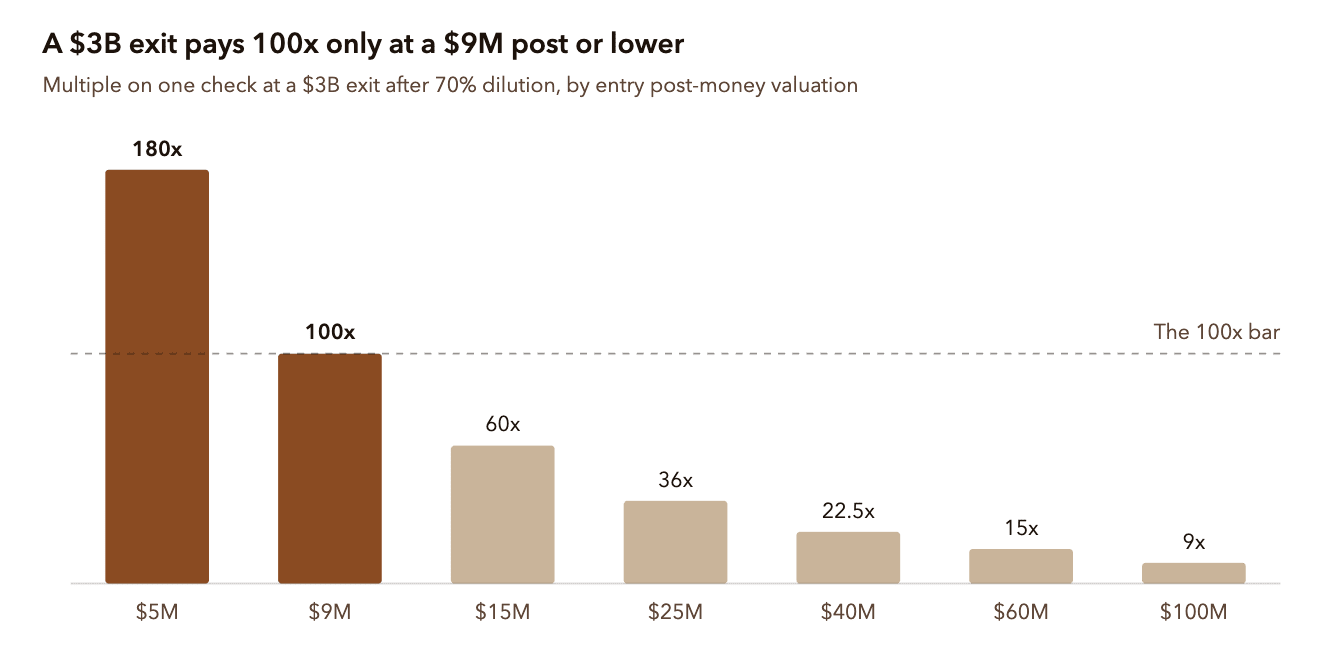
You can run the math backward before you invest. To make 100x after 70% dilution, here's the exit each entry price needs:
| Entry price (the company value you buy in at) | Exit needed for a 100x |
|---|---|
| $10M | $3.3B |
| $20M | $6.7B |
| $50M | $16.7B |
You can't do much about dilution itself, so build it into the multiple you expect before you agree to a price.
How much to invest
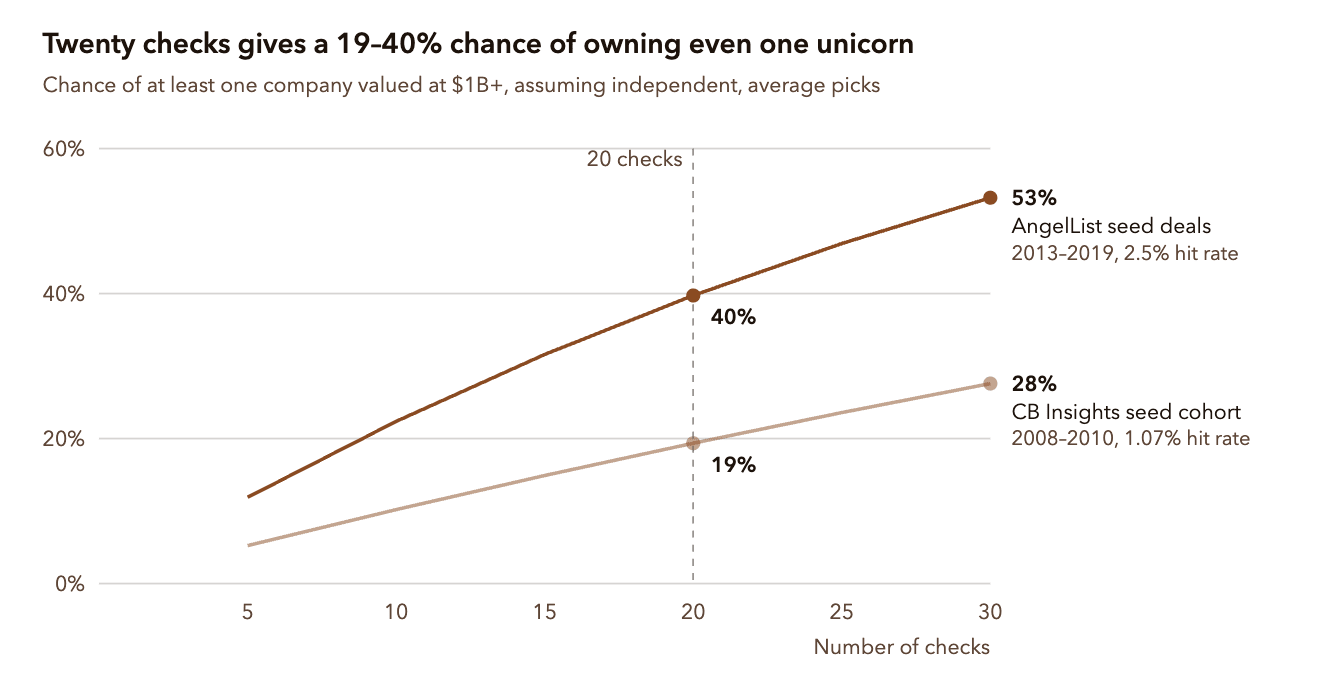
By 2012, two companies, Dropbox and Airbnb, made up about three quarters of the value of everything Y Combinator had funded. Nobody could have said in advance which two, so the other half of the math, how much money you put in, starts with a count. Decide what percent of your net worth goes to venture, then divide by 20 so you have 20 checks and enough shots on goal.
Angel checks as small as $5–10K are not uncommon, and they're fine if the founder's okay with it. These rules cover how many checks to write, how big and how fast:
- 20 should be the absolute floor. You're not done angel investing until you hit 20 deals at minimum. Winners are that lopsided everywhere, so the only way to own one is to write enough checks. And don't fear the misses: in data on hundreds of venture funds since 1985, the best funds lost money on more of their deals than merely good funds did. They swing harder (on deals that look weirder) and miss more often. Reread that if it doesn't make sense. It's a really important point.
- The newer you are to investing, the less you can trust your picking, so the more checks you should write, up to 30, let's say. I'd argue fifty personal checks is spraying and praying, though. See how your first batch performs before you do your next 20–30 investments.
- Watch the percent you invest in. Track checks written against pitch calls taken. If you're investing in many of the deals you see, you're investing wrong, because I assure you most deals are not good. For context, the median VC firm screens 200 companies a year and invests in 4, or about 2%.
- Don't pace by the calendar. Never skip a banger, a deal you're confident is great, just because you did a deal yesterday. All 20 in 12 months is technically fine, but if you do that, odds are you're rushing.
- Write the same check every time. The Kelly criterion, a formula gamblers use, says to size a check to your edge (your real odds of winning), and you don't know your edge yet. Sizing up on the one you "really believe in" is how you concentrate into the loser! So avoid that. There's a second trap too: the better the deal, the less room the founder will give you, so if your check sizes vary, your winners tend to end up as your smallest positions. Just keep it simple to start and fight for your standard check in every deal you believe in.
- Double down only when you have inside access. Doubling down means putting more money into a company you've already backed, and it's the one exception to writing the same check every time. Do it only when the company is clearly pulling ahead and you uniquely have pro rata (the right to invest later to keep your percentage) or allocation (room in the round). A hunch doesn't count, because your instinct will be wrong until you've spent years learning what a banger looks like early.
Where this fits in your financial portfolio
Here's the frank math on a 20-check angel portfolio for most people.
Even if you hit one unicorn out of 20 investments, you can still trail someone who simply bought an index fund like the S&P 500.
To match the index at its long-run 10% a year, your one winner in a 20-check portfolio has to return about 52x over 10 years. Thankfully, 52x is absolutely doable in venture—just not the norm. This is why you want to be early and come in at low valuations: for the same exit, a lower entry price means a bigger multiple. It hedges against a worse exit valuation!
Naval estimates that a competent, well-connected Silicon Valley angel with a broad portfolio might make 3x to 10x over a decade. Are you competent and well-connected? Can you get there? If not, to be honest with you, many people are okay losing the money just to play the game and be close to amazing founders and inspiring new technology.
Here's how angel checks compare with what most people already own, over the 10 years from 2016 to 2025:
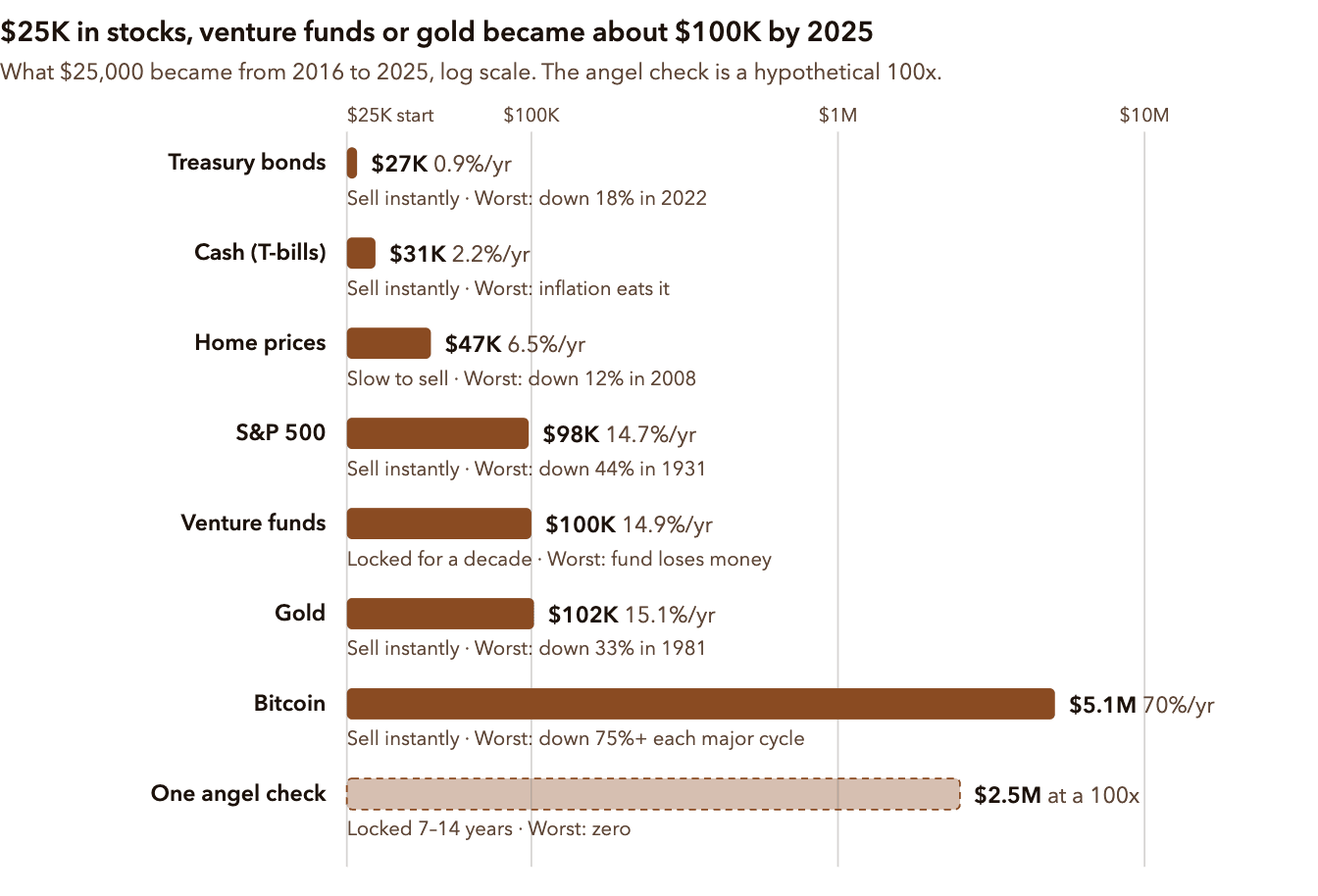
Notes: The stock, bond, cash, gold and home rows are compounded annual returns, and home prices exclude rent. The venture row is Cambridge Associates' US index, after fees, and Bitcoin is my math from its year-end prices. That was a great decade for risk, so don't extrapolate it. Over 25 years, venture returned 8.1% a year against 8.8% for the S&P. Angel checks have no reliable aggregate figure, and the 100x is hypothetical.
Convincing a great founder to take your money
Onto the third step in the venture process: winning deals.
That's getting the founder to take your money, and for an angel it's mostly asking: "I'd love to put $5K in your round." Founders generally have no problem with small angels in earlier, smaller rounds.
Still, the smaller your check, the less founders will prioritize you. In an oversubscribed round, pitch your small check as a strength: real help for very little allocation. So if you don't already have a relationship with them, give yourself an edge:
- Always be selling. Show which of your skills will help their business, with proof. If they don't think you're worth their time, they may not indulge your full diligence process.
- Be specific in how you help. Most founders will make room for someone who can bring intros, customers or a first hire, so name the people you'd bring.
- Offer to be a reference with their other investors. It helps their round and takes one phone call. This only works, of course, if you can intelligently speak to their business.
Here's the difference in an email:
| Easy to ignore | Hard to ignore |
|---|---|
| "Love what you're building! I'm an angel with a great network and I'd love to add value. Can I get into the round?" | "I ran motor sourcing at a robotics company for six years. I can introduce you to two suppliers who could cut your lead times, and to the ops manager I'd hire first. I'd love to put $5K in your round." |
After you wire
The last two steps in the venture process, offering value to founders and following on with extra capital, start after you wire.
Founders remember investors by what shows up in their inbox. Here's what that looks like:
| Annoying | Useful |
|---|---|
| "Just checking in! How's it going?" | "You said you need a supply chain lead. I worked with a great one who just left her job. Want an intro?" |
| "Let me know how I can help." | "I can get you in front of the buyer at the company you mentioned next week. Want it?" |
| "Saw the news about your competitor. Thoughts?" | "Your competitor changed its pricing last night. Here's the screenshot." |
There's one way I do encourage investors to be "annoying," actually:
- Ask for updates right away. When you invest, ask to be added to the investor updates. If you're among the first money in, help the founder start sending one every month or two, since later investors will expect it. Expect this to slow to quarterly or twice a year as they grow.
- But don't read silence as death. In our experience, lots of good founders go quiet, especially with investors who aren't a top priority for them, like anyone not on the board.
As time goes on, two pointers:
- Say no to most bridge rounds. A bridge round is when the company hasn't made enough progress to raise at a higher valuation, so it asks for more money at its old one. Say yes only if you can name what you know that the market doesn't. Otherwise, don't assume that you, as an angel, know more than the 100 VC funds looking at the deal. In the Kauffman data, ventures with a follow-on check from the same angel returned 1.4x against 3.6x without one, and bridges often go badly.
- Keep score early. Naval says it takes five to 15 years to know whether you have good judgment, so watch earlier signals. Good investors piling into a round after you is a reasonable sign. So is a markup, meaning a big jump in valuation after you invest, though it mostly shows you can read other investors' taste. So is a founder who keeps landing world-class hires. The signal I trust most is people willing to buy your shares at a higher valuation, because that means real demand exceeds what the company can supply. Treat all of these as hints, though. Graham found that how well a YC batch raised money after Demo Day said nothing about whether it held a giant, and if anything pointed the wrong way. That follows from the best deals looking weird: the companies investors chase today are often the obvious ones. So don't get cocky about a markup, and don't write off a company because nobody's chasing it.
Your first year of investing
Here's how I'd fit everything above into your first year:
- Month 1: get set up. Pick a percent of net worth and work out your check size. Start the private list of the most talented people you know. Publish a personal website showing what you're great at, and post on X and LinkedIn.
- Months 2–6: get your reps. Meet at least 100 companies before your first check, about five a week, and track deals seen against checks written. Find other angels to swap deals and notes with. Start a list of every seed company that would have paid more than 100x, and study what each looked like at the start. Those are the only companies that move a portfolio, so they're the ones to train your eye on.
- Months 7–12: write checks. Make your first ones all the same size, with a short memo for every check and every pass.
The first rewards aren't financial. Investing keeps you sharp, because smart founders will spend an hour telling you what they learned over the past year. Those rewards start with your first check.
Scouting for a fund like mine
As a reminder, scouting means sourcing deals for an existing venture fund, and it's the cheapest practice an angel can get. Sequoia's early scouts included Sam Altman, Brian Chesky and Dropbox's founders, and by 2019 more than 230 companies its scouts backed had raised over $6 billion. You put none of your money at risk and still get the potential for huge upside, because fund checks are large.
My pre-seed and seed hardware fund, Julian Capital, invests up to $3M in startups throughout the US and Canada that make something physical, from reactors and chips to robots and surgical devices. Founders we backed early include Matt Loszak of Aalo, Ian Brooke of Astro Mechanica, Hugh Kolias of Canada Rocket Co and Divya Cohen of Becoming.
I want you sending us founders, so weigh this section with my bias in mind.
Here's what you get from scouting for us:
- Earn carry with no money in. If the fund invests in a founder you referred, you can earn a share of our carry on that company under a signed agreement. You earn it by doing real work on the deal, like making the intro and telling us what you know about the founder and the market. It pays out only if the fund as a whole turns a profit, so a great company in a losing fund pays nothing.
- Help great founders get funded. You're introducing a talented friend to a fund that can move fast. Through Deep Checks, we know almost every deeptech VC. When we invest, they notice, and the rest of the round can fill within days.
- See how a fund judges founders. Learn how we do diligence, and get our take on whether a deal is the outlier you think it is.
- Build a reputation. Scouting deals counts toward your track record if you later start your own fund.
- Work with a fund founders rate highly. In a survey run by Deep Checks, which I built, 200+ deeptech VCs named the funds most helpful to founders, and our fund ranks in the top 2% of hardware funds.
That said, scouting won't teach you what it feels like to lose your own money. Only a real check does that, so once you have capital, do both—angel and scout.
Refer a founder to us on our scout page, which has the full terms.
The whole guide in four paragraphs
Angel investing is a bet on outliers. Most of your checks will lose money, and one winner has to pay for all of them, so write at least 20 checks of the same size, plan to wait a decade, and only use money you'd be fine never seeing again.
Your edge over VC funds is getting there first. The best deals come from exceptional people you already know, often the week they quit to start something, so keep a private list of the most talented people you've worked with. Before you trust your taste with strangers, see 100 companies.
Back the founder before the idea: someone world class at one thing, obsessed with the problem, fast, and able to pull great people in for a decade. Then check that the idea couldn't have worked a few years ago, that buyers are already pulling it out of the founder's hands, and that it looks weird for a reason you can explain. Most moats are illusions, so the founder's speed is usually what protects the company.
When a friend says there's someone in the garage you should meet, go to the garage.
One last thing
In 1999, a college friend of a VC tried to introduce the VC to two Stanford students renting her garage to build a search engine. Those two students turned out to be Larry Page and Sergey Brin, who were building Google. The VC replied by asking how he could get out of the house without going near the garage.