



Disclaimer: This is not personalized investment, legal or tax advice. Startup investing is very high risk, and you can lose everything you put in. In fact, you probably will.
$25,000 invested into Uber eventually became roughly $100M. That's what one early check by Jason Calacanis grew into, about 4,000 times his money.
Almost nothing in a typical brokerage account does that in a decade. The S&P 500 has averaged 10% a year since 1928, which turns the same $25,000 into about $65,000 over the same ten year span.
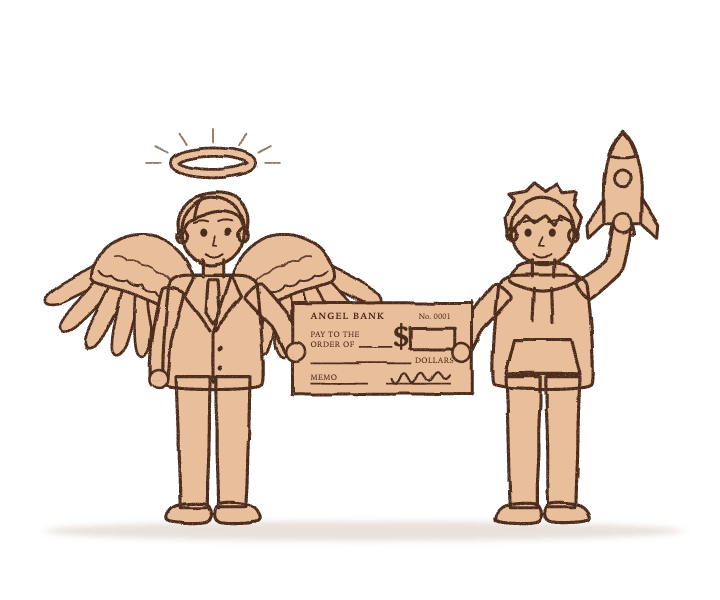
Angel investing is the rare bet where a small check can grow a thousandfold.
The money is only part of why people stick with angel investing. Here's how life gets more interesting once you start writing checks:
- Your calendar fills with the most ambitious people around you. You'll spend an hour with someone building nuclear reactors or reusable rockets, and walk out wanting to work on more meaningful projects yourself.
- Every pitch is a free crash course. The founder is the person who knows the subject best, and they'll spend an hour teaching you.
- You see the future before it's news. New technology shows up in pitches years before it shows up in headlines, so you'll understand what's coming while your friends are still reading about it.
- You get the best stories. Years from now someone at dinner will mention a company everyone uses, and you'll remember when it was three people and a slide deck that you fell in love with.
You don't need to be super rich to play this game. Many angel investors write 20 checks of $5K, so $100K in all. Let's say 19 of the 20 die and just one investment returns 100 times your money (which investors call a 100x): you'd still get back $500K on your $100K. That's about 17.5% a year if the winner pays out in year 10, against the S&P's 10%.
If $5K checks are also out of reach for you, there's a second path called scouting where you refer founders to a VC fund and shares in its profits when one works out. My fund, Julian Capital, has a scout program, which I cover at the end of this handbook. With it, you put up no money. (Legal disclaimer: that isn't an offer of carry or fund interests, and nothing is earned until a written agreement is signed.) That Uber check came from scouting! The $25,000 was Sequoia's, and Calacanis was a scout.
There are so many historical angel wins like Uber's. Here are a few:
| Angel | Company | Angel check | Became | Multiple |
|---|---|---|---|---|
| Sam Altman | Stripe | $15K | $633M | 42,000x |
| Andy Bechtolsheim | $100K | $1B+ | 10,000x+ | |
| Jason Calacanis, for Sequoia | Uber | $25K | About $100M | 4,000x |
| Peter Thiel | $500K | $1B+ | 2,000x+ | |
| Mike Markkula | Apple | $250K | $203M | 800x |
| Dan Scheinman | Zoom | $250K | $176M | 700x |
These are unaudited publicly reported figures from varying dates. They're rare outliers, not typical results or a forecast.
The latest example is Anthropic, which makes Claude. Its 2021 Series A (one of a startup's early funding rounds) came almost entirely from tech founders rather than venture capital (VC) firms: Skype cofounder Jaan Tallinn led it, with Facebook cofounder Dustin Moskovitz and former Google CEO Eric Schmidt also in. Here's what a dollar in each early round had grown into by Anthropic's last private round, $965B in May 2026:
| Round | Who got in | Valued at | Multiple by 2026 |
|---|---|---|---|
| Series A, 2021 | Jaan Tallinn (lead), Dustin Moskovitz, Eric Schmidt | About $0.6B | About 1,500x |
| Series B, 2022 | Sam Bankman-Fried's FTX, with $500M of the $580M | About $4B | About 240x |
| Series C, 2023 | Spark Capital (lead), Google, Salesforce, Zoom | About $4.1B | About 235x |
Multiples compare each round's valuation with the $965B round and ignore dilution, which shrinks every one of them. The Series A valuation is a secondary-market estimate, and individual check sizes were never disclosed. On November 10, 2026, Anthropic set an IPO price range implying about $1.4T.
Both tables show the power of venture investing: on any given check, the most you can lose is the money you put in, but a winner has no ceiling.
So a portfolio of 20 checks can absorb a lot of losses as long as one goes to the moon. You're purposefully creating a basket of long shots expecting many to die.
But let's return to reality.
Forget those outlier returns for a moment, because most people should not actually angel invest.
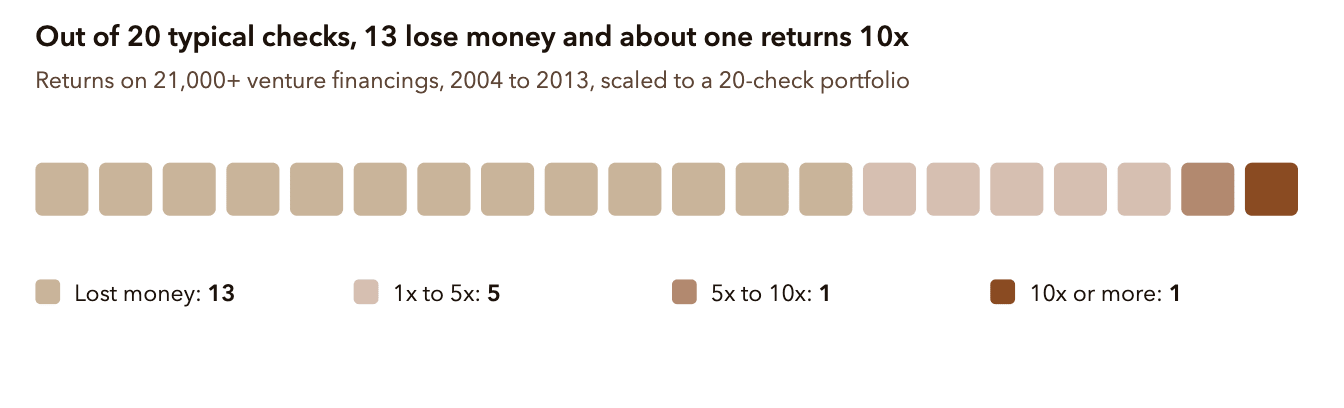
From Correlation Ventures' data on 21,000+ venture financings, 13 of the 20 lose money, and only about one returns 10x+. So unless you're good at picking and lucky enough to see the right companies, even a 20-check portfolio probably won't beat the S&P 500 over 10 years.
Therefore, don't angel invest:
- You want stability in returns.
- If you'd miss the money. Assume your money is gone the day you wire it. Naval Ravikant, who cofounded AngelList, tells new angels to think like patrons of the arts in Renaissance Italy, who paid for great work without counting on a return.
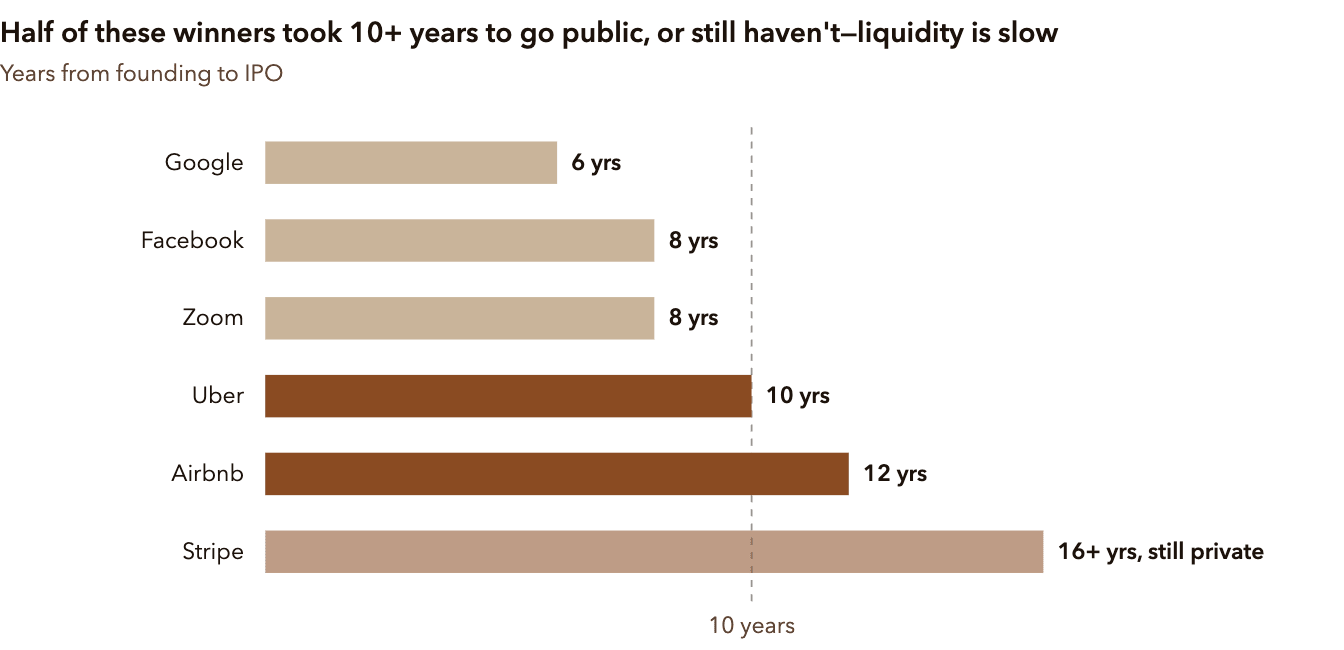
- If you might need the money back within 10 years. Winners can take 7–14+ years to pay out, and selling early is expensive.
- If you don't have the time to write at least 20 checks, which means finding companies, taking calls with founders, and diligencing them (researching them). To do this well means taking hundreds of calls over the years.
If you're still reading, I'll assume you want to take angel investing seriously: the rest of this guide helps you take a real stab at potentially making millions, using the lessons of funds like mine that invest at pre-seed or seed (a startup's first real funding round). Along the way, you'll learn to think like a VC, which helps if you ever want that career.
Exactly what you'll learn:
- How to meet your first 100 companies
- The traits shared by founders of unicorns (startups worth $1B+), and the first-call questions that expose them
- Why the best deals look weird, and how to tell a flaw from an insight
- Why most moats are illusions, and what protects a young startup instead
- The email that gets a founder to take your $5K, and why angels who invest again in the same company tend to earn less
About the author
I've invested over $100M of other people's money into over 100 startups. My investing began as an experiment. I'd spent the prior decade helping startups acquire their first 1,000 customers, as VP of Marketing at Webflow, at Heap Analytics and Clearbit, and through Demand Curve, my growth agency, which went through YC. I wanted to know if that marketing lens worked in reverse: instead of asking how to help a company grow, ask how likely it is to grow.
Isn't that how you'd pick startup winners?
I wanted to find out, so I put half my net worth into angel checks.
A handful of those checks broke out, and that track record allowed me to raise Julian Capital, my venture fund, which is now on its third vintage (each new fund is called a vintage).
Along the way, I built Deep Checks, where 40+ hardware VC funds review founders together. It's the largest hardware funding platform we know of. I also built VCSheet.com, one of the most popular sites founders use to decide which VC to take money from.
Who has an edge in investing
The best angels have three things going for them:
- They have a knack for meeting great founders before VCs do.
- Founders love them and refer them to other founders.
- They genuinely love the investing hustle.
The first is the biggest durable edge an angel has: you beat VC funds by being the person a talented friend calls the week they quit to start something. This handbook is going to spend a lot of time helping you find deals early.
The best-placed angels are therefore typically engineers at top companies, where future founders work beside them before leaving. In Ilya Strebulaev's data on 2,791 founders of US unicorns, Google was their most common former employer, with 96 of them, and Microsoft was second with 64.
Active founders are the next best angel archetype, since running a company keeps you close to the cutting edge, and former founders come after them.
But you don't need to be any of those if you're simply around a lot of new founders and have a good eye for picking exceptional people.
That eye is worth more than any finance background. Many of the newest VCs are former startup operators who led product, growth and so on, and aren't finance people at all.
You need to see volume before you invest
For every deal a VC firm closes, it considers about 100 companies on average, according to a survey of 885 VCs. Aim for the same number before your first check, because someone who's seen only ten deals can't tell a great one from a good one.
After 100 startup pitches, you can ask yourself, "Is this among the best deals I've ever seen?" and the answer means more.
Even 100 isn't a lot, though. In Morten Sørensen's study of VC deals, an investor with no prior deals backed a company that went public about 15% of the time, against 39% for one with 225 prior deals, so you'll keep improving for years. It pays to start investing now and not later.
The quickest, cheapest way to build your deal pattern matching is demo days. At a demo day, an accelerator (a program that funds and coaches a group of startups) puts its whole batch on stage in front of investors, so you can see dozens of companies in an afternoon. The filtering is done for you: YC accepts roughly 1% of the startups that apply. Go for the reps and the market read (a sense of what's being built) more than the deals.
Most good demo days are invite-only, however, or limited to accredited investors, so apply early or ask a founder in the batch to invite you.
Here are demo days to start with. I've listed the hardware ones first because that's what my fund backs, and the Best for column shows each one's focus:
| Demo day | Best for | How to get in |
|---|---|---|
| Boost VC Deep Tech | Deeptech | Online for a week, twice a year, for accredited investors |
| HAX and IndieBio | Hardware and biotech, through SOSV | Investor demo days, so ask SOSV or a founder in the batch |
| Alchemist | Enterprise startups | Invite-only, and founders in the batch can invite you |
| MIT delta v | MIT's startups | Its 2025 Demo Day had no pre-registration |
| Stanford Founders | Stanford's startups | Investors register, and operators (people who work at startups) can RSVP as guests |
| Berkeley SkyDeck | Berkeley's startups | Accredited investors apply to attend |
| HF0 | Repeat founders | Its site doesn't say, so ask a founder there |
| YC | The best-known batches | Invite-only and oversubscribed, based on recent YC investments. You can apply, and YC's directory shows every batch without an invite |
Where deals come from
Demo days are just one source of deal flow. Finding deals, called sourcing, is the first of five steps in every investment, and this guide breaks them down:
- Sourcing. Finding great founders.
- Picking. Deciding which of them to back, at what price and with how much.
- Winning. Getting the founder to take your money.
- Value-add. Helping the company after you wire.
- Follow-on. Deciding whether to invest again in later rounds.
Sourcing deals can be as simple as asking questions. Angel Cyan Banister used to ask taxi drivers about their days, which taught her how the medallion system squeezed them. One driver kept handing her the card of UberCab's Ryan Graves and telling her to invest. When she later watched Travis Kalanick pitch at an angel forum, she told her husband they had to invest that day.
Her source was a taxi ride. The mundane. To see your first 100 companies, keep your eyes open everywhere. Some sourcing channels worth knowing:
- Labs, papers and grants. This is a unique source if you're technical, because most investors can't read the work. Each week, skim new papers in your field on arXiv (a free site for new research) and new SBIR awards (US government grants for small-company research), which name the company and its lead researcher. When someone's work excites you, email them about the work itself and ask what they'd build if they left the lab. That gets you to scientists before they raise.
- Small VC funds. They see fewer deals than large funds, so each angel who sends them one matters more, and they're likelier to build a relationship with you. To bring you into a deal, though, they have to see you as useful to their founders, so make your most useful skill known.
- Your reputation. Speaking of being useful, write about what you know, and show off your value on your website, LinkedIn and X, so founders and investors can find you. It's what I do at Julian.com, and it's why you're reading this.
- Hacker News and hobbyist forums. Builders show off unfinished work there. Dropbox's founder posted his demo on Hacker News in 2007, and John Carmack found Oculus's founder on a forum for 3D display hobbyists.
- Kickstarter. Watch the top hardware campaigns. VCs passed on Pebble's smartwatch, so it raised $10M from about 69,000 backers, and the VC firm CRV invested $15M a year later.
- What your employer buys. When the engineers around you fight to buy a startup's product, you're watching its earliest revenue from the inside.
You also want to seek exceptional, outlier individuals more broadly. Look online. Watch X, LinkedIn, Substack and YouTube. When one person's work keeps reaching you from different places, read all of it, especially if others seem to be overlooking it. Then cold email the people you admire, and be stubborn.
When Snapchat ignored emails from Jeremy Liew of the venture fund Lightspeed, he ran a WHOIS lookup on the domain (a public record of who owns a website), found Evan Spiegel and sent him a Facebook message. Lightspeed then put in Snapchat's whole $485,000 seed.
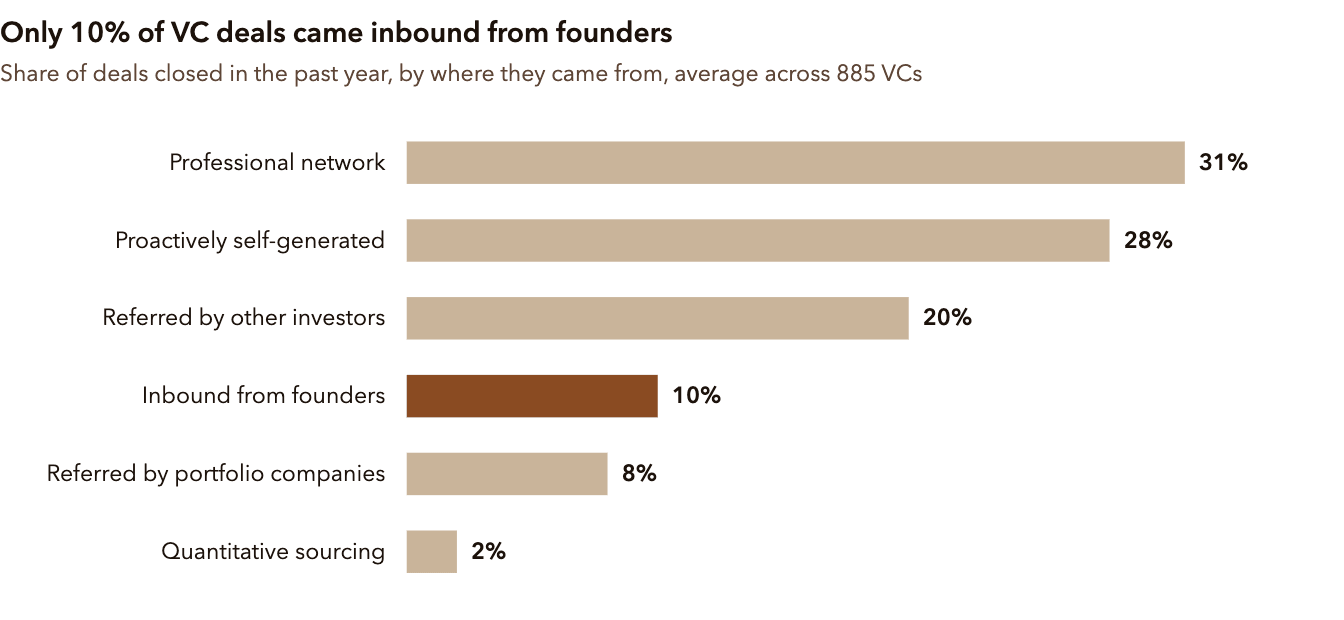
Liew's story has a second lesson: don't wait for founders to come to you. Here's where the deals in a survey of 885 VCs came from:
You want to get into deals early
When sourcing, don't be afraid of being very early. Hanging back is a common beginner mistake. Getting to a deal before VC funds is actually your edge.
When you're early, know that the best deals won't look like startup investments. Often it's a friend who quit their job and is "hacking on a side project," with no round (a formal fundraise) or pitch deck. If you think they're outlier exceptional and they're going full-time, offer the money before they ask. Be aggressive about getting that check in, because by the time they raise a real round, the valuation (the price tag on the whole company) will have gone up. On Carta in 2025, a typical pre-seed SAFE was capped at about $10M, while the median seed round closed at about $24M after the new money. And by the time it looks like a real company, you might not get in at all.
The angel's version of investing in Google is investing in it when its two founders were still Stanford grad students tinkering with a search algorithm. Your skill is to be able to squint and see the future that emerges from that seedling of an idea.
Those who can read the tea leaves of market tailwinds and cultural tides have a wildly good edge at this game.
You can get in even earlier, by the way, before there's an idea. Mike Maples of the venture fund Floodgate spent 14 months riffing on ideas with Qasar Younis before Qasar became obsessed with the idea of Applied Intuition and started it. By then they knew they wanted to work together, so Maples didn't have to compete with other firms for the deal.
To be that early, you have to know the people before they start companies. That's why your sourcing often starts with a private list of the most talented people you've ever worked with. The 50-year-old belongs on that list as much as the 25-year-old, by the way. In a study of 2.7 million US founders, a 50-year-old was 1.8 times as likely as a 30-year-old to start one of the fastest-growing 0.1% of companies. Watch for when these killers quit what they're currently working on, and while you're at it keep asking them to name the best people they've come across, so the list keeps growing.
Angels hunt for talent.
Once you branch out beyond people in your network, you need to learn to judge strangers fast (sometimes over a single Zoom call), which the next section helps you get good at.