

Disclaimer: This is not personalized investment, legal or tax advice. Startup investing is very high risk, and you can lose everything you put in. In fact, you probably will.
Addendum: Investment documents in two minutes
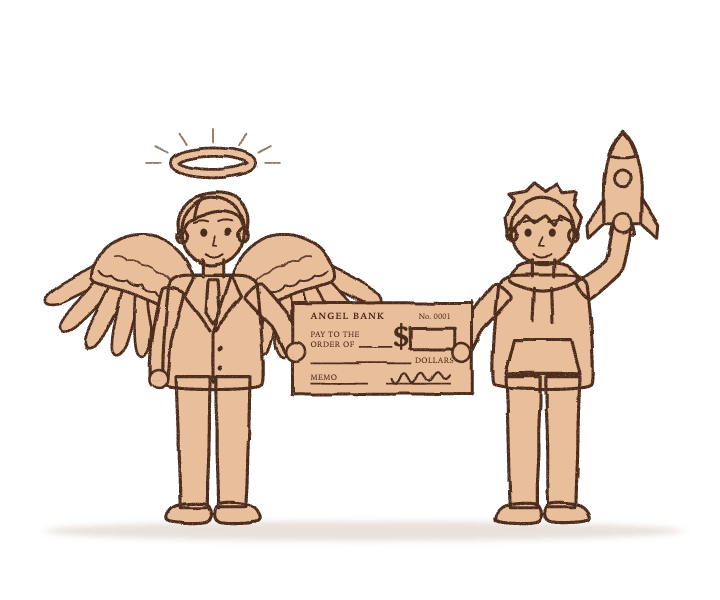
In 2012, 9,522 people put $2.4 million into Oculus through Kickstarter and got headset kits, T-shirts and posters. Eighteen months later the company sold for $2 billion, and the backers got none of it, because a pledge isn't equity.
Equity comes from the document you sign, and about nine in ten pre-seed rounds now use a SAFE (simple agreement for future equity), Y Combinator's standard contract. You give the company money today, and it turns into shares at the next priced round, when investors agree on an exact price for the company's shares. Three things decide what your money buys:
- The cap is your price. It's the highest company value your check can get priced at. Divide your check by the cap to get the percent you'll own before later rounds dilute you, so a $5K check at a $10M cap buys 0.05% of the company. A lower cap is a better deal, because the same $5K at a $20M cap buys half as much.
- You get the better of two prices. If the next investors value the company at $50M, you still pay your $10M cap, and that's your reward for going early. If they value it at $6M, you pay the lower $6M price.
- Check whether it says post-money or pre-money. The math above is for a post-money SAFE, the standard kind, whose cap already counts all the money raised on SAFEs. A pre-money SAFE looks cheaper than it is, because its cap leaves out the other SAFE money. To compare, add that money to the cap. A $10M pre-money cap with $2M raised on SAFEs is like a $12M post-money cap.
Three more things can catch you out:
- You don't own shares yet. A SAFE is a promise of shares. If the company never does a priced round and never gets bought, you may never get shares or a payout. Until it does, you usually get no vote and no right to see the company's numbers.
- I'd never go uncapped, even for a friend. With no cap, you pay whatever price the next investors set. You can get boned if they value the company at $100M when you expected $10M. An MFN (most favored nation) SAFE has the same problem. It has no cap of its own and only copies the best terms later investors get, so you have no price until one of them gets a cap.
- You may see other paperwork. A convertible note is a loan that turns into shares later, usually with a cap like a SAFE. A priced seed means you buy shares right away at a set price. Run the same math on both: your check divided by the company's value with the new money included.
Putting it together: a $5K check at a $10M cap buys 0.05%. After 70% dilution, that's 0.015%. So for a 100x ($500K), the company has to exit for about $3.3B.
Are you legally allowed to invest?
This isn't legal advice, so check your status with a lawyer. In the US, most rounds require accredited investor status, which means $1M+ net worth excluding your home, income above $200K ($300K jointly) in each of the past two years with the same expected this year, or a Series 7, 65 or 82 securities license (held by finance professionals). If that's you, skip to the first check, step by step, below.
If you don't qualify, a company can still take up to 35 non-accredited investors in a private round under the SEC's Rule 506(b), as long as they're financially sophisticated, alone or with an adviser, but it then owes them extra disclosures and financial statements, so most startups don't bother. The easier route is a crowdfunding platform like Republic. A US rule called Regulation Crowdfunding lets startups raise up to $5M a year from anyone, accredited or not, as long as it happens through a registered platform. You make an account, read the company's campaign page and SEC filing (its required disclosure to the US securities regulator), and invest. Each company sets its own minimum, often $100 or less.
That access comes with four catches:
- There's a yearly limit if you aren't accredited. It covers all crowdfunding deals in any 12 months and scales with your income or net worth, from $2,500 at the low end up to $124,000.
- You get fewer rights. Many Republic deals use a Crowd SAFE (a SAFE written for crowdfunding). The company doesn't have to turn it into shares at its next round, and you generally get no vote, even after it does.
- You can't sell quickly. Crowdfunding investments generally can't be resold for a year, and a buyer can be hard to find after that.
- You lose your edge. These companies are raising in public, so you aren't getting in before everyone else the way you do with a talented friend. I'd treat it as cheap practice and hold every deal to the same bar.
The first check, step by step
- Confirm the investment amount and the SAFE cap with the founder in writing.
- Check the SAFE they send for the cap, the amount and your legal name. Throw it into an LLM to check it's boilerplate (the standard form, with nothing unusual added), and have a lawyer look at anything unusual.
- Sign it, and get the countersigned copy (signed by the company too) back.
- Confirm the wire instructions on a call, because wire fraud is real: in 2020, Barbara Corcoran's bookkeeper wired $388,700 to a scammer whose email address was off by one letter. Make sure the money goes to the company's account, never to a person.
- Keep the SAFE, any side letters (extra agreements with the company) and the wire confirmation in a folder.
- Make sure your SAFEs would go to the people you care about if you die. SAFEs aren't on the cap table until they convert, so nobody else may know you own them (the cap table is the company's record of who owns what). Add the check to a one-page list your family could find: company, amount, date, where it's held and any special terms. Update the list once a year.
Master cheat sheet
The main rules.
| Step | Rule of thumb |
|---|---|
| Before you start | Invest only money you won't miss or need for 10 years, with time for 20+ checks and access to founders. Otherwise, buy the index. |
| Your edge is knowing great founders before VCs do. | |
| Meet 100 companies before your first check. The exception is an exceptional friend who just quit. | |
| Sourcing | Keep a private list of the most talented people you know. Then hunt through labs, syndicates, other angels and small funds, and hold strangers to a higher bar. |
| Get in before there's a round. With an exceptional friend, offer the money before they ask, then wire only against a signed SAFE and a company that exists. | |
| Cold email the people you admire, and be stubborn about it. | |
| Picking founders | Exceptional, deep, fast, lasting: spiky with a growth curve, outlier execution, the idea maze, obsession, speed, a magnet for people, mission and ethics. |
| Open the call with the origin story, then dig into weak spots. | |
| Picking markets | The best deals look weird. Your job is telling a flaw from an insight, so ask people who live with the problem. |
| Look for something that couldn't have worked 24–48 months ago, a tailwind within 2 years, nothing on the way that makes it irrelevant, a path to $3B+, a first buyer, and a story Series A funds will buy by the next round. | |
| Most moats are illusions. What works is staying 1.5 years ahead and building goodwill with buyers. | |
| Diligence | Pitch potential customers, ask for proof of demand, call references and experts, and write a memo before you wire and when you pass. |
| Don't say yes on the call unless it's a friend you've watched for years. If you don't know within 14 days, you should probably pass. When in doubt, say no. | |
| Price and size | Come in as low as you can, with a path to 100x. After 70% dilution, a $10M entry needs a $3.3B exit for that. |
| Decide what share of your net worth goes to venture and divide it by 20. Write the same check every time, and double down only with inside access. | |
| Most 20-check portfolios miss a unicorn. To match the index, one check has to return about 52x if the rest go to zero. | |
| Winning | Ask, and offer specific help: names, intros, a first hire. |
| After you wire | Get in touch only with something specific, and ask to be on the investor updates. |
| Say no to most bridge rounds, and don't get cocky about a markup. | |
| Your first year | Month 1, get set up. Months 2–6, meet 100 companies. Months 7–12, write your first checks, each with a memo. |
| Paperwork | The cap is your price, and never go uncapped. Confirm wire instructions on a call. |
Disclaimer
This guide reflects my opinions and public sources I believe are reliable but haven't independently verified. It isn't personalized investment, legal or tax advice, and reading it creates no advisory relationship. It isn't an offer to sell or a solicitation to buy any security, and it isn't an offer of carry or fund interests. Startup investments are illiquid and high risk, and you can lose all the money you invest. Past results, including the examples here, don't predict future results. The portfolio math is hypothetical and before taxes, fees and carry. I run Julian Capital, which invests in startups, including in sectors discussed here. Talk to your own advisers before investing.